How We See Stereoscopic (3D) Depth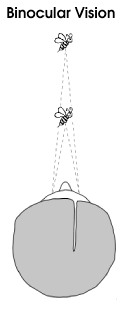
By Dennis Brown from the Original Viewmagic
Viewer Manual
We perceive depth mainly by binocular vision. W W e get absolute and relative
distance information in two different ways.
For close distances the eyes rotate inward until the object is in the center
of vision for both eyes. The more they rotate, the closer the object. By
experience from childhood we learn exactly how far we must reach to touch an
object.
We sense the relative distances between objects within our binocular field of
view by how much difference in position there is between the objects as seen by
the two eyes.' If there is too much difference between the two views, instead of
giving us a sense of depth, all we get are double images.
This double image factor is important to consider in taking stereo
photographs. A stereograph is more enjoyable to look at if we can view the
picture without any double images. Then we can perceive all the depth from
foreground to background.
With stereography you can increase the perception of depth for distant scenes
by using a wide camera separation. This will bring out the depth in a picture
that would be impossible to see in any other way.
An interesting aspect of binocular vision: when we look at a scene, we
perceive our vision coming from an imaginary eye halfway between our real
eyes.
Binocular vision is the sense that gives us a direct sensation of space. It
is absent from flat photography. No wonder so many people have to excuse their
vacation pictures with, "You just have to go there to get the feel of the
place." Now we can all have much more of the "feel" of the place
through stereography.
' The sensitivity of this sense varies between people, but may
be improved with the regular use of a stereoscope.